Tokwe nuclear test and the framing of the narrator
The IPCRESS FileThe Tokwe nuclear test and the framing of the narrator turn a night of surveillance into a prosecution built from incomplete images, technical evidence, and a dead soldier. As the sky flashes with the force of daylight near Shot Island, the Unnamed narrator is stopped on a closed road; within minutes, a tower soldier is found dead and the narrator is arrested. Later, the investigation presents a high-speed television system designed to monitor a neutron bomb and fingerprints on its wreckage as evidence against him. The episode’s central reversal is that the narrator can read the surveillance material as proof of a larger operation even as the authorities use the same investigation to make him its apparent culprit.
The road, the flare, and the arrest
At 2:12 a.m., the narrator reaches a red warning sign ordering traffic to halt 25 yards ahead. The section is closed, leaving three miles of forbidden road between him and his destination. Dalby, who has driven ahead, has already slipped through. This separation matters: the narrator is stranded on one side of the closure while Dalby’s route and whereabouts remain beyond immediate view. The narrator has reason to hope Dalby might help if the road sections are closed, but the barrier makes that hope uncertain.
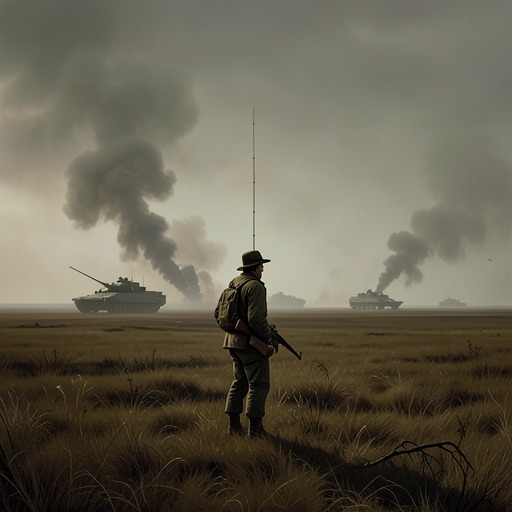
The sudden light interrupts the stalled journey. The narrator is still waiting for his cigarette lighter when the sky bursts into brightness; after opening the car door, he rolls out into a white, day-like night. The quiet that follows is broken by a siren from the far side of Shot Island. Two police helicopters approach, dropping hand grenades into the sea as their searchlights sweep the area. The Air Police have located and followed the large flare. One helicopter circles back to the narrator’s car, while its loudspeaker orders him not to move.
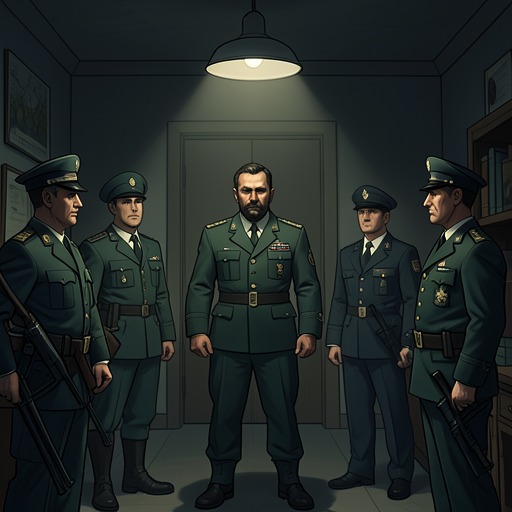
The lights reveal the tower and its dead occupant. A search beam climbs the steel ladder and picks out a soldier hanging partly through the shattered window. The narrator understands that the man is dead: the tower is connected to a high-tension power line through metalwork, angle irons, and bolts. This discovery gives the night a human consequence distinct from the spectacle in the sky. At about 2:36 a.m., a Provost-Colonel arrives to arrest the narrator. Half a minute later, the narrator remembers the heavy insulating gauntlets in the car, but recognizes that recalling them then could not have changed what had happened.
The tower death and the accusation
The next day, The Brigadier identifies the dead man as Corporal Steve Harmon and tells the narrator that Harmon is the person he killed the previous night. The accusation converts the tower discovery into a personal charge. The earlier image of the body, glimpsed in a searchlight, had seemed to explain itself through the lethal electrical connection; The Brigadier’s identification attaches responsibility to the arrested narrator. The narrator is thus confronted not only with the consequences of the night but with an official account that treats his guilt as settled.
The evidence shown to him complicates that account without immediately clearing him. The Brigadier explains that a portable camera-transmitter had been directed at the mountain. It sent high-speed electrical impulses carrying pictures, so that camera movement would not prevent clear images from being transmitted. The narrator compares the principle to a slow-motion film’s reduced camera shake, and The Brigadier agrees. The explanation makes the equipment’s purpose legible: it was not simply a conventional camera recording a still scene, but a means of transmitting a moving sequence at exceptional speed.
Reading the island’s surveillance record
The Brigadier’s film reconstructs the road through the island’s network of infrared cameras. Each camera transmits on the same frequency, and the receiving equipment renders the island’s side as a distorted map. In the footage, the narrator’s car appears as a white shape travelling up the screen. When the manned tower connects to the electric cables, its camera goes out of action; overlapping camera coverage nevertheless preserves the journey. The image then breaks into intense horizontal bands, which The Brigadier identifies as the high-speed television transmission. Somewhere in those bands, the flare appears.
The helicopters enter the recorded sequence as small, quivering marks and return to the narrator’s car. But the film’s most consequential detail comes when the laboratory splices the arrest into the end of the footage. Two cars are visible coming down the road from the top of the screen, while another enters from below. The narrator already knows Dalby travelled ahead along the highway; seeing the two vehicles distinguished on the record leads him to infer that Dalby had found a way to make his car invisible to the island’s radar defences. The surveillance film therefore yields a discovery about Dalby even as it fails, in the narrator’s view, to show the full operation behind the test.
The neutron bomb and the manufactured case
The technical explanation also changes the meaning of the camera system. A neutron bomb, The Brigadier explains, is intended to remain over a city and bombard it with neutrons, rather than produce only one large flash like a hydrogen bomb. A still photograph would disclose little about its progress; continuous pictures would be useful. The high-speed transmission is thus linked to observing the bomb’s effects, not merely to recording the flare. What first appears as an obscure apparatus becomes part of the test’s intelligence infrastructure.
The narrator connects this account to a small slip of paper found earlier in a cranberry box. Its very-low-frequency radio wavelength, he understands, was a standard means of communicating with submerged submarines, while the compass bearing was intended to set the camera’s electro-gyroscope. His luck, as he sees it, was that he did not put the slip in his pocket. These details suggest an operation involving communications and carefully oriented imaging, but the episode does not establish every participant’s role. Instead, the film’s limits and the narrator’s deductions leave a gap between the visible record and the larger mission.
The next day, officials show the narrator the high-speed television unit’s twisted black metal parts and photographs. The heavy handles are less distorted than the thin casing, and investigators appear to have recovered a substantial set of fingerprints. The prints are the narrator’s, although he insists he never touched the unit. Their presence gives the accusation a material foundation while contradicting his account, making the apparent proof an instrument of the framing. The sequence ends not with the evidence resolved, but with its double force exposed: the surveillance system reveals Dalby’s passage and the neutron-bomb monitoring operation, while its wreckage and fingerprints help implicate the narrator.